
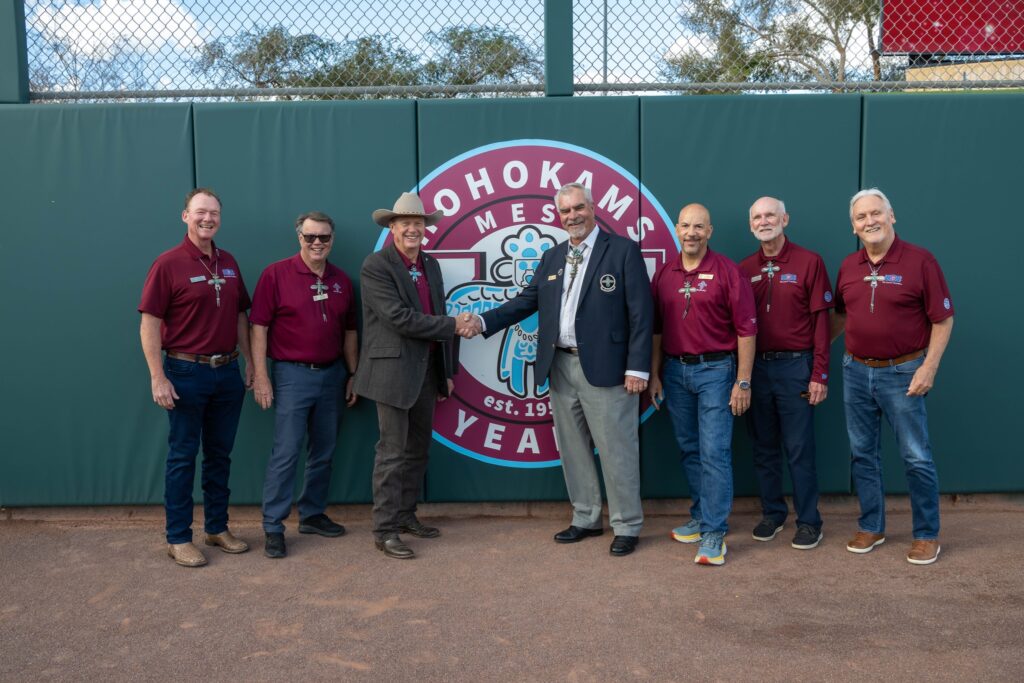
Celebrating 75 Years of the Mesa Hohokams
The crack of a wood bat and the sun-drenched bleachers of Hohokam Stadium are iconic symbols of spring in Mesa. But for those who live here year-round, the true spirit of the season isn’t just found in the box scores—it’s found in the “invisible infrastructure” of service that has sustained our city for three-quarters of a century. This year, we celebrate the 75th anniversary of the Mesa Hohokams, a milestone that honors a legacy far greater than the game of baseball itself.
A Vision Born in the Desert
In 1951, a local rancher named Dwight “Pat” Patterson saw more than just dusty fields when he looked at Mesa; he saw a destination. Alongside a small group of civic-minded boosters, Patterson founded the Hohokams to bring Spring Training to our community.
What started as a mission to put Mesa on the map has evolved into one of the most enduring civic legacies in Arizona. For 75 years, the Mesa Hohokams have been the backbone of the Cactus League, contributing more than 500,000 volunteer hours. From managing parking and program sales to serving as the city’s primary ambassadors, these volunteers have turned a seasonal pastime into a permanent economic engine.
The Power of the “Community Dividend”
The Hohokams’ impact extends well beyond the outfield walls. While the organization is instrumental in the success of Spring Training—which brings millions of dollars in economic activity to Mesa—they treat these efforts as a “Community Dividend.” The funds raised through their volunteer work aren’t just numbers on a ledger; they are investments in our future. Over the decades, the Hohokams have funneled millions into local youth sports, education, and nonprofits. This selflessness is what Mayor Mark Freeman often refers to when discussing the unique character of our city.
“The City of Mesa is built on a strong tradition of volunteerism,” Mayor Mark Freeman recently noted. “Our residents give their time and heart through programs, events, and service projects across the city. These efforts bring people together and make Mesa a stronger, more connected community.”
Leading with a “Problem-Solver” Mentality
For Mayor Freeman, the Hohokams represent the gold standard of civic engagement. Born and raised in Mesa, the Mayor has seen firsthand how organizations like this bridge the gap between government and the people.
“I just like to be a problem solver,” Freeman has said of his leadership style. “My goal is to foster stronger connections between residents and city staff so that every resident feels the genuine support of a friend and a dedicated public servant.”
The Hohokams embody this “friend and servant” approach. By handling the logistics of Spring Training, they solve a massive operational puzzle for the city every year, allowing Mesa to shine on the national stage while maintaining its small-town warmth.
A Historic Milestone
Seventy-five years is more than a number; it is a testament to perseverance. From the foundational history now preserved in the Arizona Baseball Museum to the recent America250 commendation, the Hohokams are an integral part of the Arizona story. They have survived economic shifts and stadium changes, always keeping their focus on the “Chief Big Ho” philosophy of community first.
As Mayor Freeman often highlights in his vision for an “Elevated Mesa,” the strength of our city isn’t found in its infrastructure of steel and concrete, but in the people who build it.
“Mesa’s strength is its people,” Freeman emphasized during his swearing-in. “Together, we will address challenges while building a brighter future. Mesa is an All-America City because of all of you—your dedication and your hard work.”
Looking Ahead to the Next 75
As we look toward the future, the Mesa Hohokams continue to evolve. They are no longer just a “booster club”; they are a professional-grade volunteer corps that serves as a model for cities nationwide.
Mayor Freeman commends every Hohokam—past and present—for their unwavering commitment. Here’s to 75 years of service, and to the many more generations of volunteers who will carry the torch for Mesa.